Early Civilizations and Societal Foundations
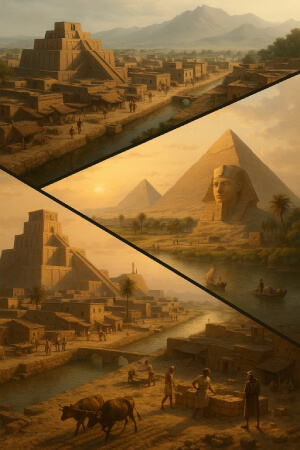
The earliest civilizations established the structures, systems, and cultural norms that formed the basis for later societies.
Mesopotamia and the Fertile Crescent
Often called the “cradle of civilization,” Mesopotamia was home to some of the earliest cities, writing systems, and legal codes. Societies like Sumer, Akkad, Babylon, and Assyria developed organized governance, monumental architecture, and advanced agriculture, laying the groundwork for urban life.
Ancient Egypt and the Nile
Egyptian civilization centered around the Nile River, which provided fertile land for agriculture and supported complex religious and political structures. Pharaohs ruled as both political and religious leaders, while advances in architecture, mathematics, and medicine illustrate the sophistication of Egyptian society.
Indus Valley and Early Asian Societies
The Indus Valley civilization, with cities like Mohenjo-Daro and Harappa, showcased early urban planning, trade networks, and social organization. In parallel, early Chinese civilizations along the Yellow River developed writing, philosophical traditions, and dynastic rule, influencing East Asian cultural foundations.
Classical Civilizations and Cultural Achievements
Classical civilizations like Greece and Rome expanded upon earlier developments, contributing philosophy, democracy, law, and arts that have left a lasting imprint on global culture.
Ancient Greece: Philosophy and Democracy
Greek city-states such as Athens and Sparta introduced key concepts in governance, philosophy, and art. Athens pioneered democratic principles, while philosophers like Socrates, Plato, and Aristotle explored ethics, politics, and knowledge, establishing frameworks still studied today.
Rome: Law, Engineering, and Empire
Rome’s influence spanned law, engineering, and military organization. The Roman Republic and later the Empire created legal codes, roads, aqueducts, and monumental architecture. Roman law continues to influence modern legal systems, while Roman literature, rhetoric, and governance shaped Western political thought.
Other Classical Societies
Classical India and China made significant contributions as well. In India, the Maurya and Gupta Empires advanced political organization, trade, and science, while philosophies such as Buddhism and Jainism shaped ethical thought. In China, Confucianism, Daoism, and innovations in technology and governance formed cultural pillars that endure today.
Mythology, Heroes, and Beliefs
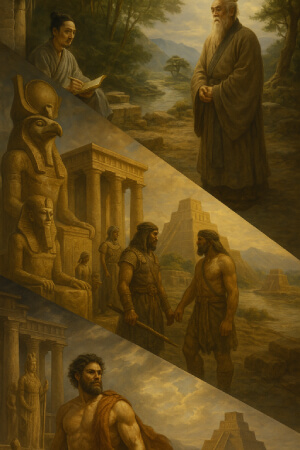
Mythology played a central role in shaping ancient societies, providing explanations for natural phenomena, moral guidance, and cultural identity.
Greek and Roman Mythology
Greek myths told of gods, goddesses, and heroic figures like Hercules, Achilles, and Odysseus. These stories explored themes of fate, morality, and human emotion. Roman mythology adapted Greek tales while emphasizing civic virtues, heroism, and divine favor in public life.
Egyptian and Near Eastern Beliefs
Egyptian mythology revolved around gods connected to natural and social order, such as Ra, Osiris, and Isis. The afterlife and concepts of judgment guided societal behavior and monumental construction. Similarly, Mesopotamian myths, including the Epic of Gilgamesh, explored heroism, mortality, and human-divine relationships.
Philosophical and Ethical Systems
Classical societies also developed philosophical and ethical frameworks to complement mythology. Confucian and Daoist thought in China, Stoicism in Greece and Rome, and Vedic teachings in India influenced personal conduct, social norms, and political organization.
Cultural Contributions and Legacy
Ancient and classical civilizations contributed arts, literature, architecture, and scientific knowledge that continue to resonate.
Literature and Drama
Epic poetry like Homer’s Iliad and Odyssey, Roman poetry by Virgil, and classical Greek dramas established narrative traditions and theatrical techniques that influence storytelling today.
Art and Architecture
Monumental architecture, sculpture, and decorative arts communicated cultural values and religious devotion. From the pyramids of Egypt to Greek temples and Roman amphitheaters, these structures demonstrate technical skill, aesthetic vision, and social organization.
Science, Mathematics, and Philosophy
Advances in astronomy, mathematics, medicine, and engineering reflected systematic observation and intellectual inquiry. Figures such as Archimedes, Hippocrates, and Aryabhata exemplified the integration of practical knowledge with philosophical reasoning, laying the groundwork for future scientific development.
Understanding the Foundations of Civilization
Delving into ancient, as well as classical, history will teach you about the inception of human culture, social, and philosophical thought; from the ancient cities of Mesopotamia to the philosophical achievements of Greece and Rome; this civilization has imprinted the modes of modern language - law, religion, and arts.
Related Topics

U.S. History Explained: Major Events, Cultural Trends, and Politics
American history offers a rich and evolving view of the events, ideas, and cultural movements that have shaped the nation over centuries. From the earliest indigenous societies to contemporary political developments, exploring this history reveals the social, economic, and cultural forces that define the United States today. This page highlights key historical moments, significant cultural shifts, and political evolution, providing a comprehensive perspective on America’s past and its enduring influence on the present.
Continue Reading...
The World of Shakespeare: Genres, Themes, and Lasting Influence
William Shakespeare is widely considered to be one of the most important writers in the English language. His plays, writings, and poems reflect a tradition that has survived for more than four hundred years. It is important to read Shakespeare effectively in order to examine his genres, the usual themes of his drama and passions, and the historical and cultural context of his age-along with contemporary rethinking of his work. This page offers a comprehensive introduction for the reader interested in the timeless relevance.
Continue Reading...
Classic Literature: Archetypes, Themes, Influential Authors & Critical Interpretation
Classic literature represents the enduring works of the literary canon, reflecting the values, struggles, and imagination of past societies. These works, spanning poetry, novels, plays, and essays, have influenced generations of writers and readers, offering insights into human nature, culture, and morality. Understanding classic literature requires examining its archetypes, recurring themes, influential authors, and the critical interpretations that continue to shape our reading today.
Continue Reading...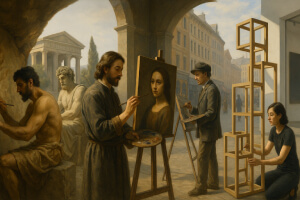
Art History: Influential Artists, Movements, Architecture & Cultural Works Across Eras
Art has always existed as a reflection of the human condition, culture, and perhaps what human beings feel. The gamut of art, from cave drawings through contemporary installations, has largely been a process of reflection-the history of art reflects on the evolution, belief and humanity's creative endeavor; it tells us how various societies have conveyed their ideas, celebrated their memories, or set norms through visual culture. Such discussions expand toward some artist and movements including avant-garde and architecture and culture. These are naturally critical concerns from one realm of activity to another in our modern universe.
Continue Reading...Quick Links
Teaching FORM through Lady Macbeth’s tragic arc has really helped my students to see how Shakespeare builds tragedy through character. It’s been a game-changer for their analytical writing and for pushing students towards grade 8&9.#teamenglish #macbeth #gcseenglish #literature pic.twitter.com/34SMhdu3dc
— Abena Appiah (@AbenaAppiah) December 4, 2025
Quick weight loss sounds tempting — keto hacks, protein shakes, extreme diets… but what’s the real cost? 😳
— B L Mittal (@blmittal01) December 7, 2025
Dr. Rahul Jain breaks down the hidden dangers behind “fast results” and why safe, sustainable weight loss always wins.#HealthFirst #DietRealityCheck #WeightLossFacts pic.twitter.com/OGyipeCdX3